
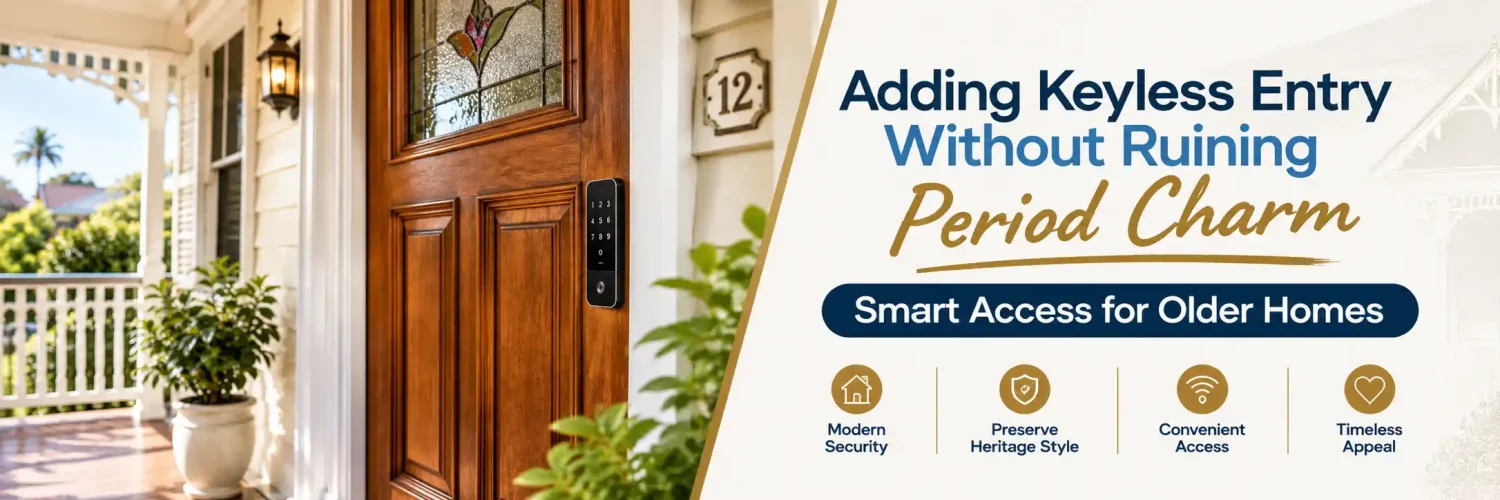
Coorparoo is full of homes with real character. Timber front doors with decades of history, original hardware, leadlight panels, and the kind of detailing that simply is not replicated in modern builds.
It is understandable, then, that many owners of these homes hesitate when the topic of smart locks comes up. There is a common assumption that keyless entry means chunky modern hardware bolted onto a beautiful old door, undoing decades of character in the name of convenience.
The reality is more flexible than that, and with the right approach, it is entirely possible to add smart access without compromising the look of a period home.
Why Older Homes Present a Different Challenge
Modern homes are typically built around standard door and frame dimensions, which makes fitting most smart locks a fairly straightforward, predictable process. Older homes rarely offer that same consistency.
Door thickness can vary significantly from what is considered standard today, original hardware may use backset measurements that modern locks are not designed around, and timber doors that have settled and shifted slightly over decades can make even simple lock swaps more involved than expected.
There is also the matter of preservation. Many older doors in Coorparoo have original brass or timber detailing that owners understandably do not want drilled into unnecessarily or replaced with something generic. Any smart lock solution for a period home needs to account for all of this, rather than assuming a one size fits all installation will work the same way it does on a brand new door.
Retrofitting Versus Full Replacement
The first real decision point is whether to retrofit smart technology onto existing hardware or replace the entire lock assembly with a smart unit. Retrofitting typically involves adding a smart module to the interior side of an existing deadbolt, essentially motorising or digitising the way the bolt is turned while leaving the exterior appearance, including the original keyhole and exterior hardware, completely unchanged.
This is often the preferred route for heritage focused homeowners, since from the street or the front porch, the door looks exactly as it always has.
Full replacement, by contrast, swaps out the entire lock and often the exterior faceplate as well. This can offer more features and sometimes better long term reliability, but it is a more visible change, and for a home with original hardware that owners want to keep, it is usually the less appealing option unless the existing lock is already failing or unsuitable for other reasons.
For most character homes, a retrofit approach strikes the right balance. It allows the practical benefits of keyless access, such as remote unlocking, temporary codes for guests or tradespeople, and the ability to track who has entered and when, without altering the door’s external appearance at all.
Working With Timber Doors
Timber doors require a slightly different level of care than the engineered doors found in most modern builds. Older timber can be more prone to movement with humidity and temperature changes, and doors may have been repainted or refinished multiple times over the years, sometimes changing their effective thickness slightly at the point where hardware sits.
Before any installation, it is worth having the door and frame properly measured and assessed rather than assuming a smart lock marketed as universal will simply fit. Backset measurements, the depth of the existing bolt mechanism, and the condition of the timber around the current lock all affect what will and will not work cleanly.
A poorly fitted retrofit on a timber door can lead to a stiff or unreliable mechanism, which somewhat defeats the purpose of upgrading in the first place.
In some cases, minor reinforcement of the timber around the strike plate or bolt area is worthwhile before installing a smart lock, particularly on older doors where the wood has softened slightly over time. This is a small, largely invisible step that meaningfully improves how reliably the new mechanism will perform.
Preserving the Exterior Look
For homeowners specifically concerned with street appeal and period authenticity, the exterior face of the door is usually the priority. Many retrofit smart lock systems are designed so the visible components remain on the interior side only, meaning the original keyhole, handle, and any decorative escutcheon on the outside stay exactly as they were.
Where an exterior component is unavoidable, such as with certain keypad style smart locks, there are now slimmer and more understated designs available compared to earlier generations of smart lock hardware, which tended to be bulkier and more clearly modern in appearance. Choosing a finish that closely matches existing hardware, such as aged brass or matte black to suit the home’s existing palette, goes a long way toward keeping the change visually unobtrusive.
What Features Actually Matter for a Period Home
It is easy to get drawn into every feature a smart lock advertises, but for most homeowners in older properties, a smaller set of practical features tends to matter most. Remote locking and unlocking is useful for letting in trusted visitors, tradespeople, or family members without needing to be home.
Temporary or scheduled access codes are particularly useful for anyone who regularly has cleaners, gardeners, or other service providers visiting on a set schedule, since access can be limited to specific time windows rather than handing over a permanent key.
An access log, showing when the door was locked or unlocked and by which method, adds a layer of awareness that traditional locks simply cannot offer. For homes that see a reasonable amount of foot traffic, whether from family, guests, or service visits, this kind of visibility is often more valuable in practice than the more novel features some smart locks advertise.
Battery backup and a manual key override are worth checking carefully before purchase. A smart lock without a reliable manual override becomes a serious inconvenience the moment its battery dies or its electronics fail, and for an older home where a locksmith visit might already involve some careful handling of period hardware, having a fallback option matters more than it might for a newer property.
Connectivity Considerations in Older Buildings
Older homes were not built with modern wireless connectivity in mind, and thick original walls, particularly brick or solid timber construction common in many Coorparoo properties, can sometimes affect the range or reliability of certain smart lock systems, especially those relying on a hub placed elsewhere in the home. This is worth testing or at least discussing before installation, since a smart lock that struggles to maintain a reliable connection undermines the entire point of upgrading.
Choosing Between Keypad, App, and Fob Based Access
Smart locks generally offer a few different methods of access, and older homes benefit from thinking through which combination actually suits the household rather than defaulting to whichever option is most heavily marketed. A keypad style entry works well for households that want to avoid relying on a smartphone entirely, and it is particularly useful for issuing temporary codes to guests or service providers without needing to hand over a physical fob or key.
App based access, controlled entirely through a smartphone, tends to suit homeowners who want remote control and detailed access history, but it does introduce a dependency on phone battery life and connectivity that some people find less reliable than a physical backup method. Fob based access, similar in concept to a car key, offers a simpler tap and enter experience that some older homeowners find more intuitive than navigating an app, though it lacks some of the remote management features the other options provide.
Many smart locks now support a combination of these methods, allowing a household to use whichever suits a given moment. For a period home, this flexibility is often the most practical outcome, since it allows the household to lean on whichever method feels most natural without being locked into a single, potentially inconvenient system.
Involving a Locksmith Rather Than a General Handyman
Given the specific challenges older doors and hardware present, it is worth having a qualified locksmith handle the installation rather than treating it as a general handyman task. A locksmith who regularly works with period properties will be familiar with the kind of backset variations, timber movement, and hardware inconsistencies that are common in older Coorparoo homes, and will be equipped to make small adjustments on the spot rather than forcing a modern lock into a door it was never quite designed for.
This matters particularly for the installation itself, since a slightly misaligned strike plate or an improperly seated retrofit module can lead to a smart lock that works inconsistently, undermining confidence in the system even when the underlying technology is perfectly sound. Getting the physical installation right the first time avoids a cycle of troubleshooting that often gets unfairly blamed on the smart lock itself rather than the fit.
Conclusion
The goal with any smart access upgrade on a period home should never be to make the house look modern. It should be to add convenience and improved access control quietly, in a way that respects the character that made the home worth preserving in the first place. Done properly, a visitor standing at the front door sees the same timber, the same brass, the same detailing that has been there for decades. It is only from the inside, or through the ease of managing access without endless key cutting, that the upgrade becomes apparent at all.
For homeowners in Coorparoo weighing up whether smart access and period charm are actually compatible, the honest answer is that they usually are, provided the approach is tailored to the specific door and home rather than treated as a generic, one size fits all installation.